The Moat
A rapidly deployable line of towers that puts a defence line between wildfire and the community — stood up in hours, autonomous once running.

Nick Hill
Founder, Carmanah Wildfire. 15+ years of wildfire field leadership.

Dakotah Daily
Wildfire geospatial specialist and experienced project manager.
Brian Mueller
Design, welding, and fabrication; UAV and systems expert.

Dr. Mehran Mehrandezh
PhD, Professor of Industrial Systems Engineering.

Amirhossein Moshtaghioun
Embedded systems, neural net deployment, and real-time sensor fusion.

Yassine Bouhamed
Computational fluid dynamics modelling of spray coverage and system economics.
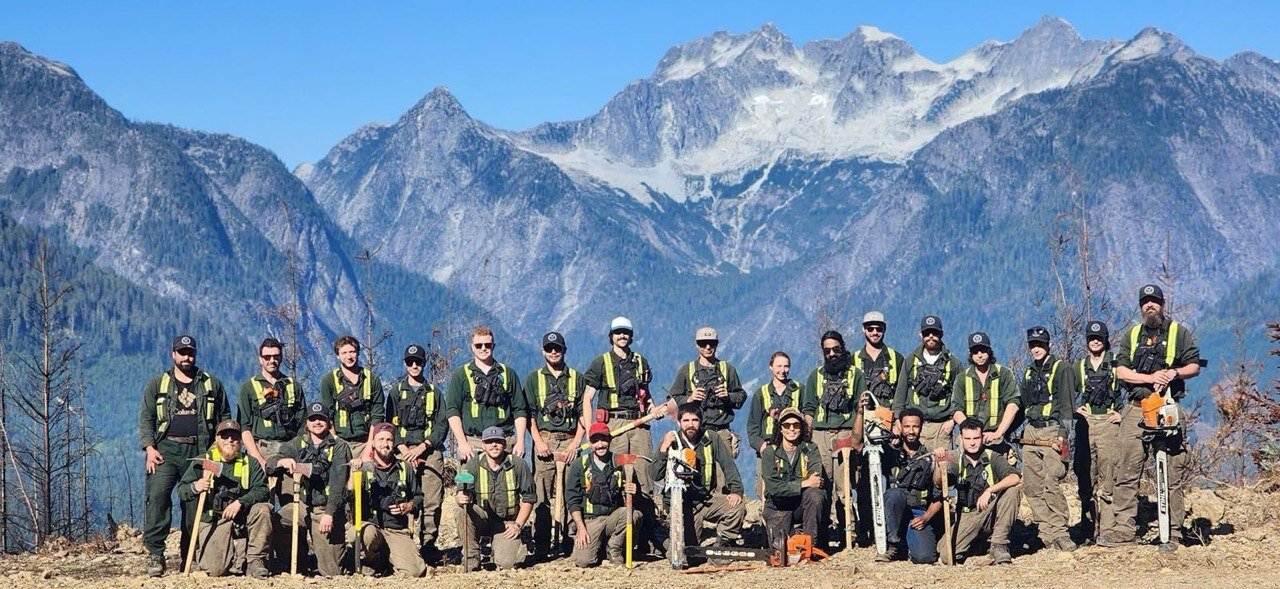
Founded in 2019 — boots on the ground since 2021, grown from 30 to 160+ seasonal employees delivering wildfire response across BC, Alberta, and the Yukon.
Type II & III Fire Crews
Reliable, mentorship-driven wildfire crews for extended suppression and complex operations.
Wildfire & Crew Training
Hands-on programs for communities, industry & First Nations — plus internal boot camps to international standards.
Falling, Danger Trees & Vegetation
Certified fallers and DTAs for land clearing, ROW maintenance, and hazard-tree removal.
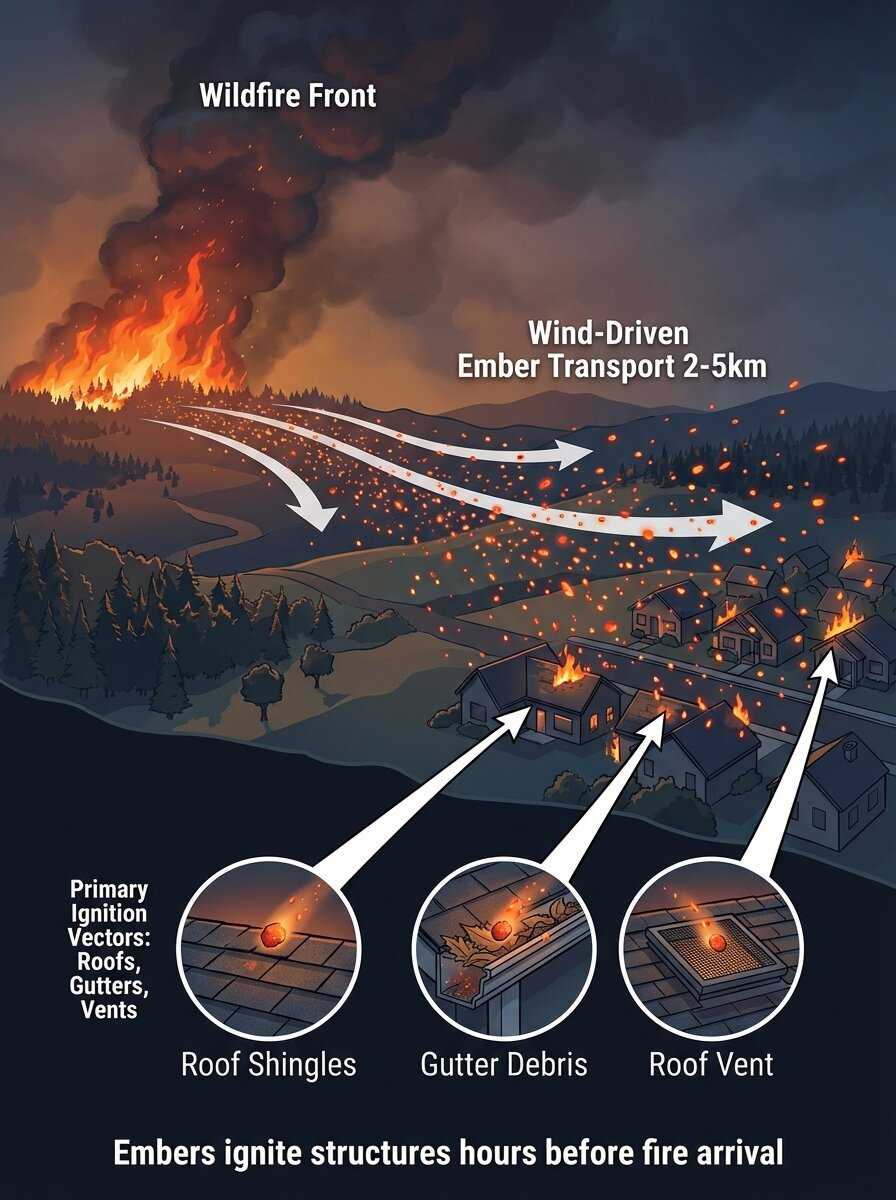
Burning debris is launched ahead of the fire front by convective updrafts — igniting structures hours before the flames arrive.
- Embers flank the line.
- They split resources at the worst possible moment.
- They turn defended communities into new fire sources.
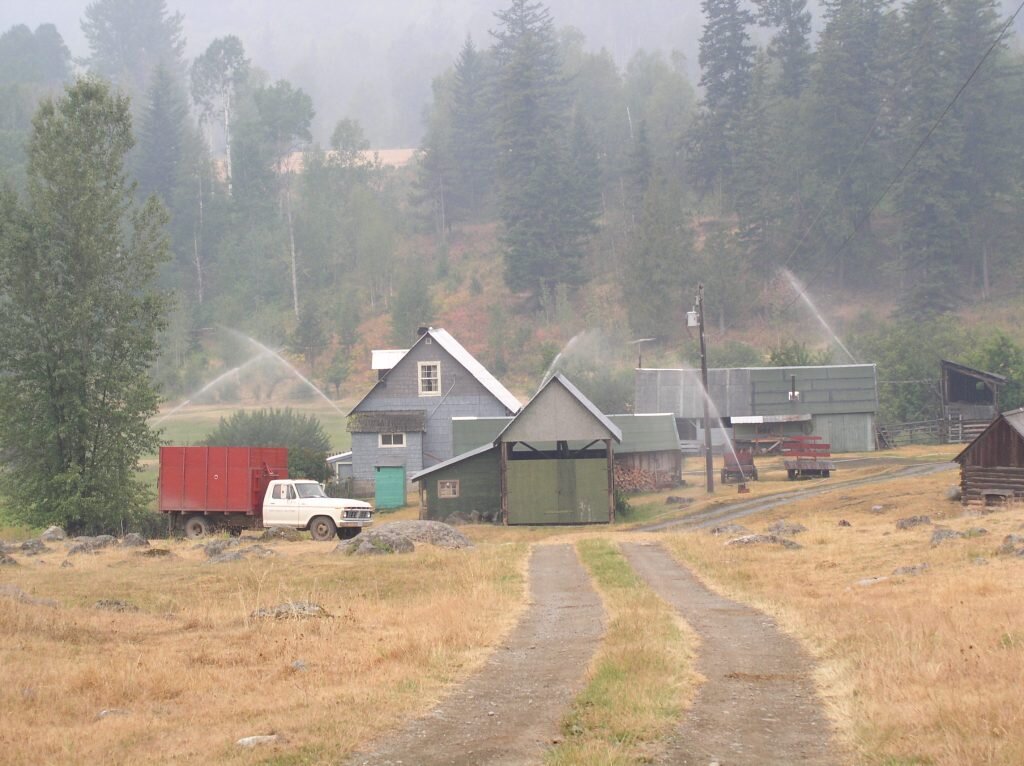
We've built and deployed wildfire defense systems in the field — and seen what works and what doesn't.
- Structure protection pre-wets buildings with large water-moving systems, creating a humidity dome.
- It has saved thousands of homes — but setup time limits its reach when fires move fast.
- The answer: a pre-staged, rapidly deployable trailer already on site, holding the line before the fire arrives.
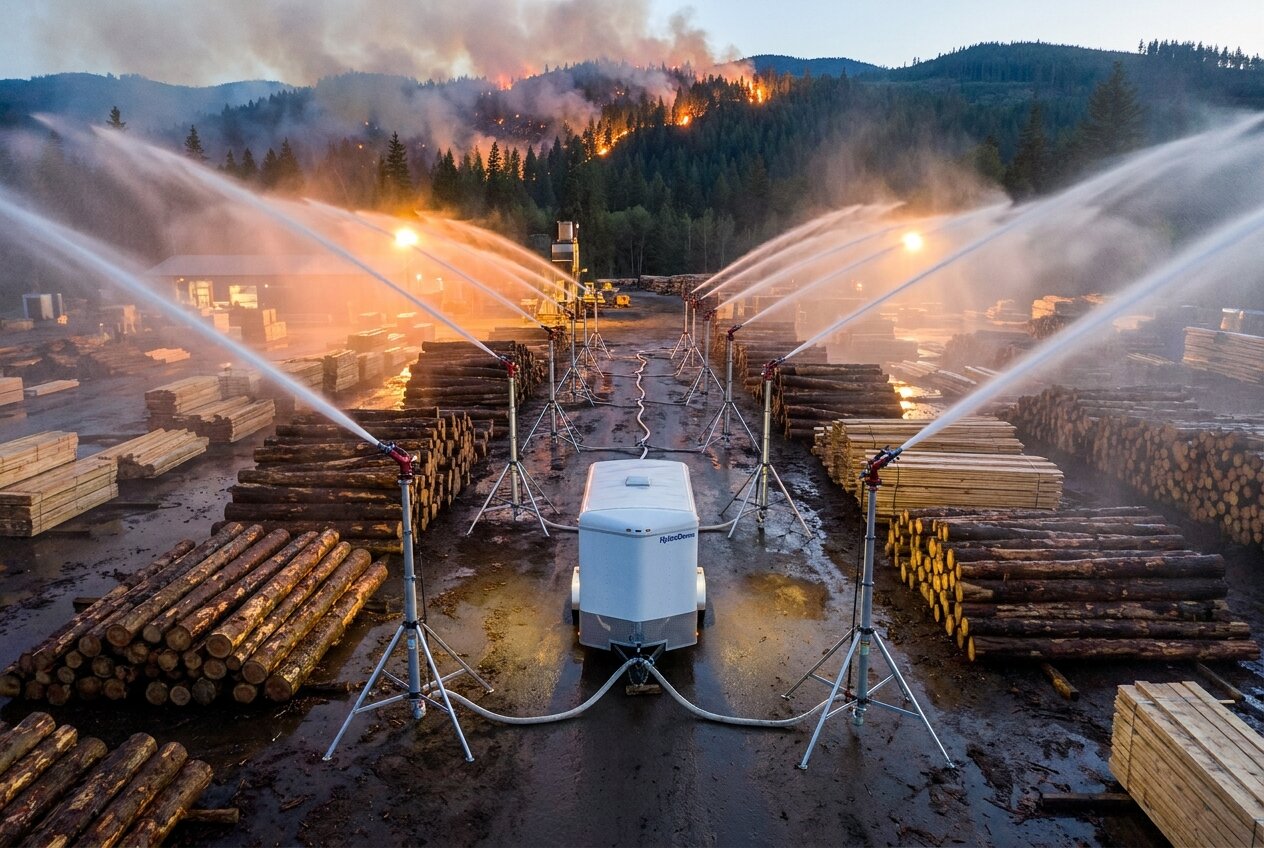
- Sequentially sprays 8 Nelson Big Gun towers along a 500–800 m line, covering 6–8 hectares — two or three towers per side run at a time, so the pumps are sized for the running set, not all eight.
- Fewer, larger sprinklers mean a two-person crew stands up the full line in under an hour.
- Sequential spraying runs on two ~50 kW portable fire pumps instead of a ~300 hp cannon plant — either pump alone can carry the line.
- Once the crew leaves, the line runs itself. It fires on live fire weather and reports back over satellite.
- A new category: more coverage and less setup than a structure trailer, smaller and cheaper than a single giant cannon.
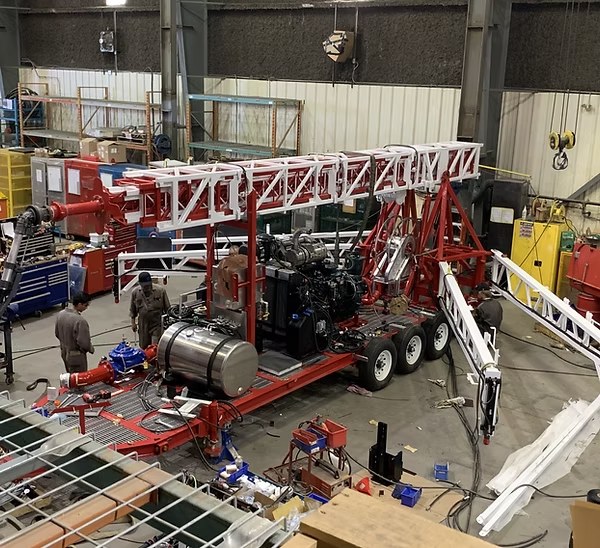
- Two UP4 pumps share a manifold, so they can run together or independently.
- Running together meets the pressure and flow the system needs; running independently gives redundancy.
- The manifold outlet feeds the main trunk line.
- The trunk line has branches that feed the sprinkler towers.
- Each tower has a pressure regulator, so pressure is evenly distributed across the system.
not much water
- Every tower has a valve, so towers can be turned on and off in sequence.
- Running towers in sequence makes the most of the power available from the pumps and the water available from whatever source we’re drawing from.
- That is what lets us run really big sprinklers, and a lot of them, over a large area — on a relatively small pump and not much water.
- This is the same strategy irrigation has used for a long time. It is proven, not new.
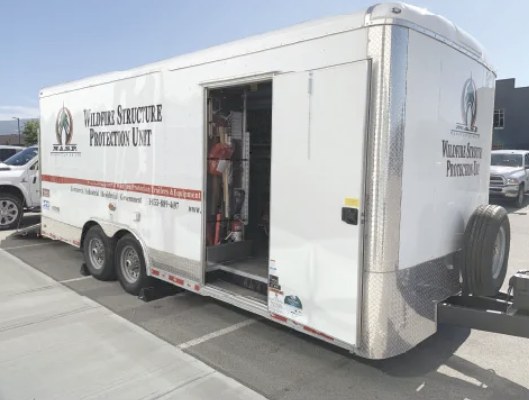
Packed up: a traditional SPU
- Inside, hose is up on the wall and the fittings and jewellery are stored alongside, like a normal SPU.
- At the back, there are slots for all the sprinkler towers and the hard suction hose.
- A back door gives access to the two UP4 pumps and the manifold, where the hoses hook up.
Set up: all wireless
- All the nozzles are controlled wirelessly from the LoRa radio in the trailer.
- The pumps are controlled wirelessly too, so a UP4 can be pulled out and carried closer to the water source when needed. Pumps are bad at sucking but good at pushing, so getting the pump close to the water matters.
- The link is two way: the towers report back, for example whether a tripod tower is working properly.
Open data in, a defensible line out — on any community, before we break ground.
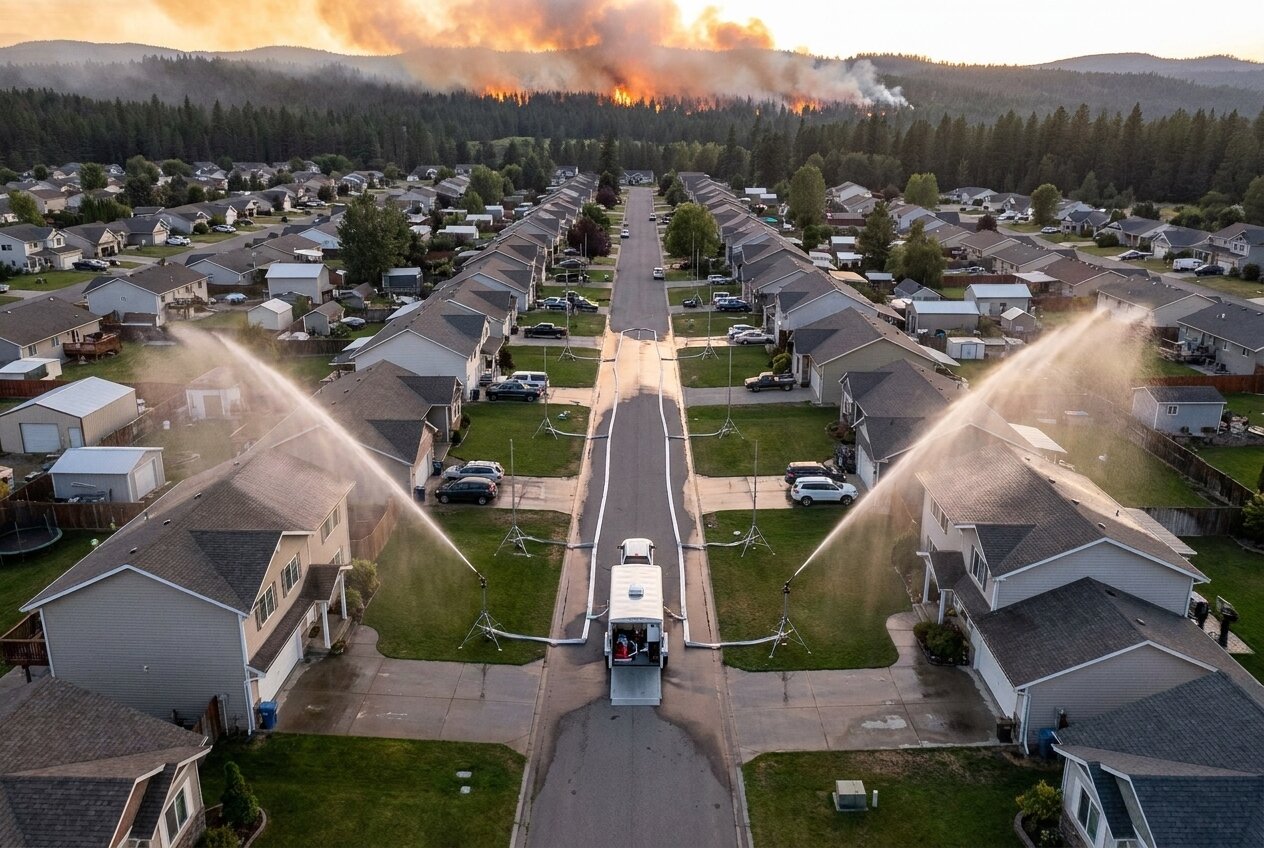
Real CAD, real spacing: eight towers on the shoulder of one street at 80 m centres, the trailer at the crossing, jets alternating north and south across a 48 m throw.
vs WASP — SPU Trailers
- 2-person, under 1 hr deploy vs. a 5-person crew at ~1 hr per structure — a ~15-hour job across 25–30 structures.
- Wets the entire zone (~8 ha), not just structures — roughly double WASP's wetted footprint and denying ember cast in the gaps WASP leaves dry.
- A handful of large heads instead of 100+ small components to set up and maintain.
vs FireWolf — Single Cannon
- Broad-area ember defense vs. point suppression — complementary, not interchangeable.
- ~8 ha zone coverage vs. FireWolf's single ~1.3 ha point — roughly 6× the area at comparable cost.
- Pre-wets ahead of the front instead of chasing a hot spot.
vs RainStream™ — Telescopic Towers
- Same wind-carried principle, but a much smaller pump by firing sequentially instead of one giant cannon.
- Lower cost (~$700K CAD RainStream vs. the Moat's ~$300K target) for comparable or greater coverage.
How it works
- Type 2 Structure Protection Unit — a rolling warehouse of 100+ sprinklers (gutter mounts, roof butterfly sprinklers, ground spikes) and up to 15,000 ft of forestry hose.
- Crew manually plumbs each structure, creating individual "humidity bubbles" over 25–30 scattered structures.
Shortcomings
- Only wets the structures and their immediate footprint — the land between properties stays dry, so embers can still ignite vegetation and spread structure-to-structure.
- Highly labour-intensive: roof climbing, hand-laid hose, no remote or autonomous operation; hundreds of small components to install and maintain.
How it works
- Robotic thermal-imaging water cannon (Unifire Force 50) on a telescoping mast; the camera detects the hottest point and auto-aims — active fire suppression, not pre-wetting.
Why the Moat is different
- FireWolf fights an active fire at one point; the Moat pre-wets an entire protected zone before the fire arrives.
- 8 sprinklers across the trailer's coverage vs. one cannon — roughly 6× the area — and at lower cost than FireWolf's robotic platform.
How it works
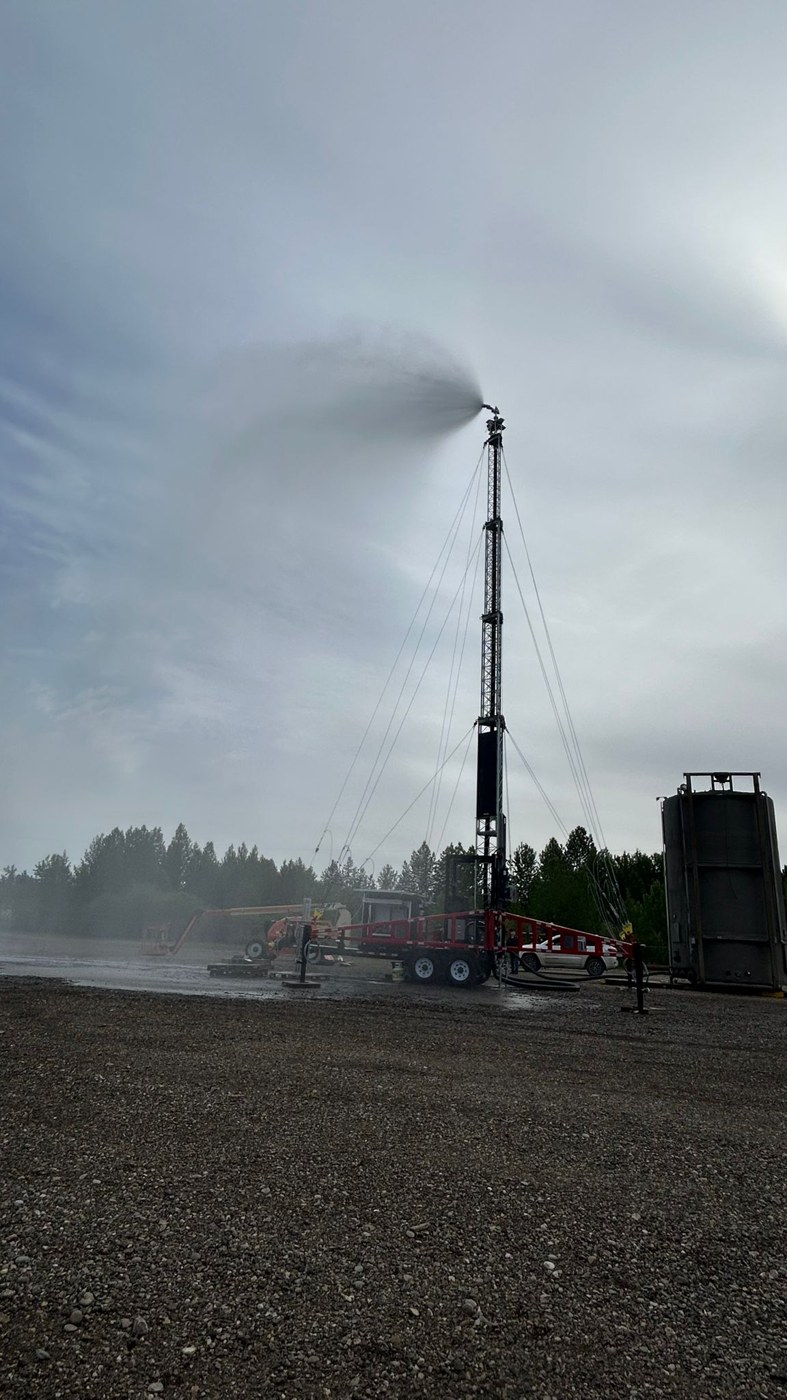
- Trailer-mounted engine/pump driving a single ~100 ft (30 m) telescoping mast with one high-volume cannon on top — a "sprinkler on steroids."
- Positioned on the upwind edge; launches water ~100 ft up so wind carries a dense mist downwind, forming a "synthetic rain" curtain over the footprint.
Shortcomings
- One giant cannon running continuously demands a large pump — which drives the size, weight, and ~$700K price.
- Coverage swings hard with conditions — the 1–18 acre range tells the story; a calm or wrong-direction wind day shrinks the protected footprint.
Predict where embers land — apply exactly enough water, nowhere wasted.
- Real-time weather monitoring — predicts where embers will land.
- CFFDRS fine-fuel moisture (FFMC) + ember-ignition thresholds — meters exactly the water the fuels need, then re-wets only as they dry.
- Tower-by-tower sequencing — covers the whole line on a pump plant sized for the running set, not all eight towers.
- Smart water management — auto-adjusts spray and pump cycling.
- LoRa radio to every tower, satellite backhaul — no cellular needed, and the line keeps running if comms drop.
- Single dashboard — live flow, pressure, water, and fire-weather.
Mitacs × University of Regina
Our R&D engine: Mitacs funds and embeds a PhD engineering team at the University of Regina that is building and testing the Moat prototype.
NRC IRAP
Canada's flagship industrial R&D program — funding plus a dedicated Industrial Technology Advisor guiding us from prototype to commercial product.
Global Affairs Canada
CanExport Innovation grant (approved) — funding international R&D partnerships and export-market expansion for the Moat.
ISED — Accelerated Growth Service
A federal advisor who coordinates government programs and connections to help scale the Moat as a high-growth Canadian company.
Revenue beyond grants
Sawmills, mines, pipelines, data centres, airports, ski resorts, and remote camps can buy a deployable unit directly.
Flexible ownership
Sell, lease, or a "Moat Ready" annual contract — the customer owns the asset and deploys it when fire threatens, with no standing crew.
Faster deployments
A property owner's two-week decision beats a multi-year municipal cycle, with a clear, direct return on investment.
The mobile Moat comes first — but our longer-term goal is HydroDome, a permanent, always-on version built into the community itself: a network of fixed towers that blanket a whole town in protective moisture the moment wildfire approaches.
- Always ready, one-button activation — no crews, no setup. Each tower sprays a curtain of moisture that stops wind-blown embers from igniting roofs and gutters.
- Works when the grid is down — buried 8,000-gal cisterns fed by the municipal main, with buried propane backup that also delivers emergency power to the community.
- Built on the same trailer control system, scaled to a permanent installation, and compatible with existing municipal water systems — complements fire departments without adding operational burden.
- Envisioned first community pilot: Fort St. James, BC — ~20 towers protecting the hospital, emergency shelter, and municipal core.
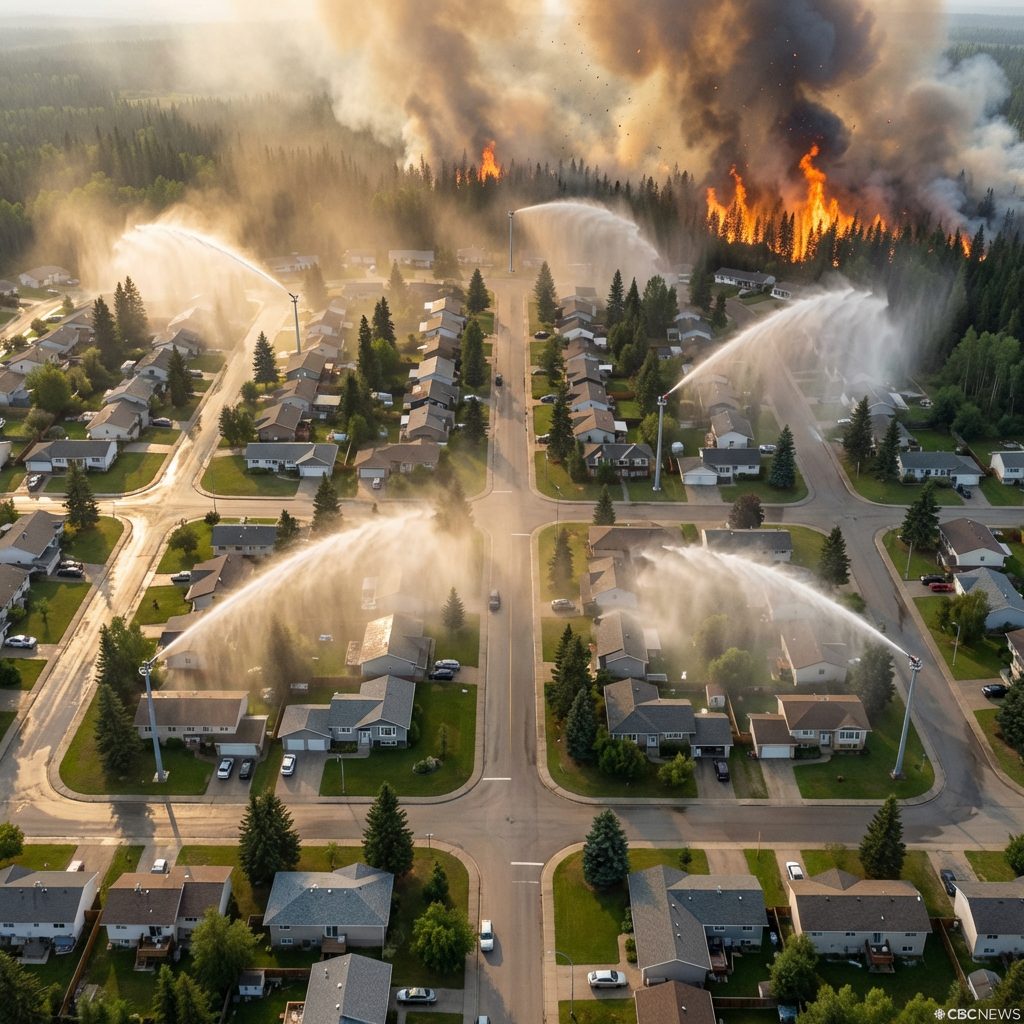
Wildfire defence & smart water management — protecting communities and critical infrastructure before the fire arrives.
Nick — 250 588 7544